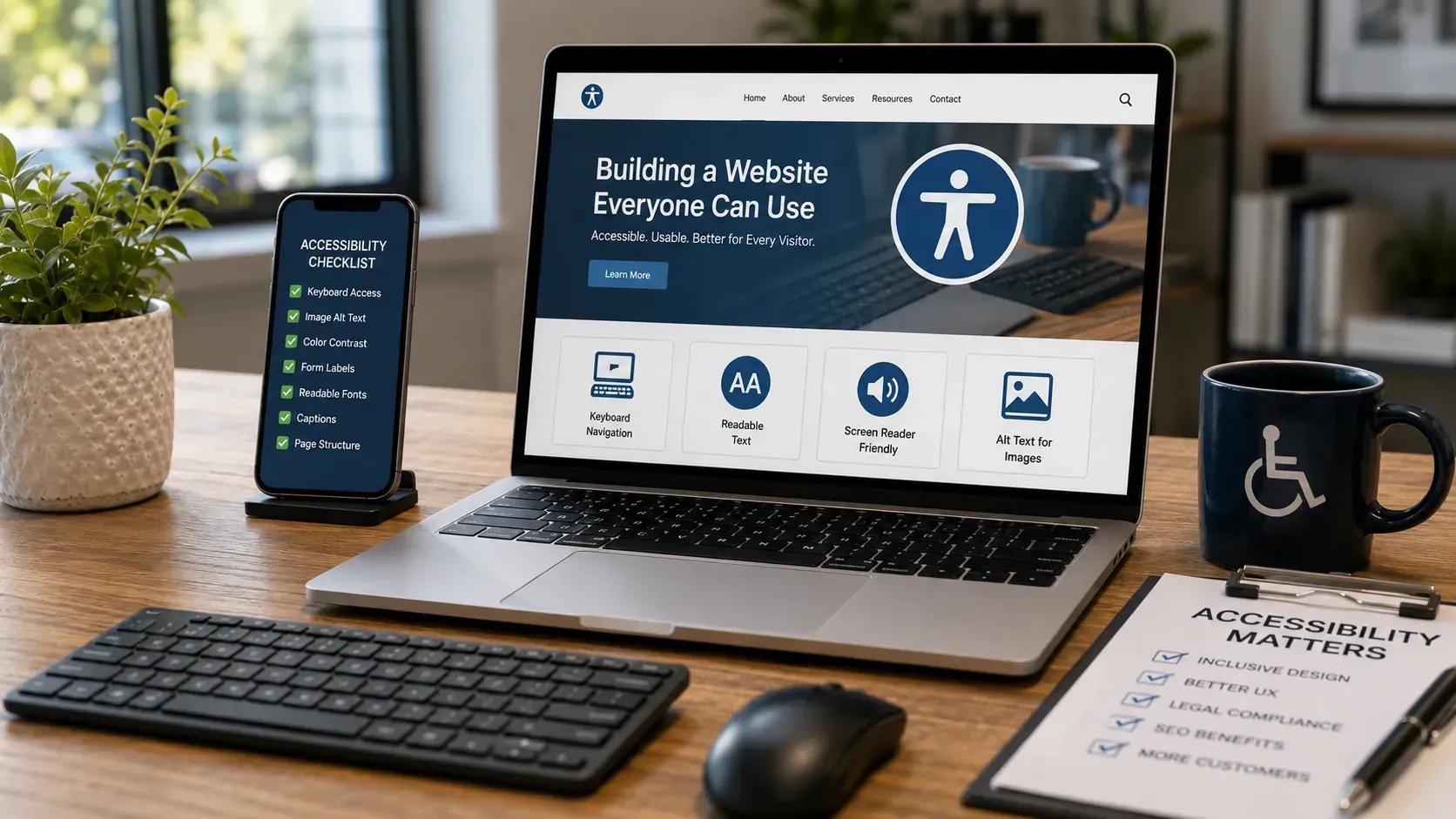
A winning local business website isn't the most visually polished one or the most expensive one to build. It's the one structured around what a visitor needs to see within the first few seconds to stay on the page and take action. For most local businesses across the Bay Area and beyond, that gap between what the site shows and what the visitor needs is the real reason the phone isn't ringing.
Key Takeaways
- Most local websites fail because they describe the business instead of answering the visitor's immediate question
- Every ad dollar spent on Google or Local Service Ads is multiplied or destroyed by the page it leads to
- Speed, mobile layout, and visible trust signals are the three fastest conversion levers for most local service sites
- Google's local ranking algorithm reads your website as direct evidence of relevance, and a weak page actively suppresses your position
- UPM Digital Media builds conversion architecture into every site from the start, paired with a dedicated local marketing expert who knows your specific market
Why Do Most Local Business Websites Fail to Convert?
The failure is almost never the design. It's intent mismatch.
When someone clicks your listing in a local search result, they've already made a micro-decision. They picked you over everyone else on that results page. They arrive with a specific question forming, something close to: "Can this business solve my problem today, and can I trust them enough to call?" Your website has a few seconds to answer both.
Most local sites answer neither. They open with a hero image, a tagline about commitment to quality, and a navigation bar. The visitor has to scroll, click, and hunt to find a phone number, a service area, or a single reason to trust the business. Most visitors don't do that work. They go back to the search results and call your competitor instead.
That's the root of local website underperformance. The page was built to showcase the business, not to close the visitor who just arrived ready to decide.
What Does Conversion Architecture Actually Look Like?
UPM Digital Media's approach to winning websites starts with one question most agencies skip entirely: what does this specific visitor need to see in the first few seconds to stay on the page and take action?
The answer varies by business type. The structure doesn't.
Conversion architecture is the deliberate arrangement of page elements to move a visitor toward a single defined action. Every section either reduces friction or builds trust, in that order, with nothing on the page that doesn't serve one of those two purposes.
For a local service business, it plays out like this. The headline names the service and the location, specifically. Not "Welcome to our company." Something like "Emergency Plumbing in Redwood City, CA, Available Today." The visitor knows within seconds they're in the right place.
Immediately below that, a trust signal appears before anything else asks the visitor to act: a review count, years in business, or a service guarantee. This answers the "can I trust them?" question before the visitor has to go hunting for it.
Then the call to action. One action, prominent, and repeated: a phone number, a contact form, or a booking link, whichever the business actually wants the visitor to use. Everything else on the page exists to remove the objections that would otherwise stop someone from pressing that button.
Services, photos, team bios, and FAQs all play a supporting role. They handle hesitation. They don't narrate the company's history.
How Does Your Website Connect to Your Ad Performance?
This is where most local businesses quietly bleed budget without understanding exactly why.
Local Service Ads place your business at the very top of Google's results, above standard paid ads, carrying a Google Guaranteed or Google Screened badge. The leads that arrive through LSAs are genuinely warm. The visitor has already cleared a trust threshold by clicking a Google-endorsed result.
What happens next is entirely determined by the page they land on.
Consider a situation where a Bay Area home services company runs LSAs for a specific service. The ads generate clicks. But the page those clicks reach is the company's general homepage, with no mention of that specific service in the headline, no local phone number visible without scrolling, and a contact form that asks for several fields before the visitor has committed to anything. The trust that Google built through the badge disappears the moment the page fails to match it. Those clicks don't convert, not because the ads failed, but because the page did.
Because that landing page failure is invisible inside the ad reporting dashboard, the business concludes the ads aren't working and turns them off. The ads weren't the problem. The page was.
Effective Local Service Ads management treats the ad and the page it leads to as one system. Optimizing the ad while ignoring the destination is like running a strong sale and then locking the front door.
What Is the Real Cost of a Site That Doesn't Convert?
Every dollar spent on Google advertising or pay-per-result SEO is either multiplied or destroyed by your website's conversion rate. A site converting a higher percentage of its visitors from the same traffic volume doesn't just look better in reports. It produces structurally more customers from an identical budget, because the cost per acquisition drops without spending more on acquisition.
More traffic to a page that doesn't convert isn't an opportunity. It's a larger version of the same waste, scaled up.
| Scenario | What Actually Happens |
|---|---|
| Strong ads, weak landing page | Budget funds clicks that bounce; ad platform's learning algorithm may optimize toward low-quality traffic patterns over time |
| Good SEO rankings, slow mobile site | Page load time is a documented Google ranking factor; high bounce rates signal low relevance and suppress rankings |
| Consistent traffic, no visible trust signals | Visitors leave to verify you elsewhere and frequently don't return |
| Full-funnel approach with UPM Digital Media | Ad targeting, landing page quality, and follow-up are aligned; each channel reinforces the others |
| Waiting to address conversion issues | Every day the page underperforms compounds lost revenue from traffic you're already paying to acquire |
How Does UPM Digital Media Actually Build a Winning Website?
The process starts before anyone opens a design tool.
Every client engagement at UPM Digital Media begins with a structured discovery phase. What does this business actually sell? Who is searching for it? What geography matters? What does the ideal visitor need to do when they arrive? From there, a dedicated account manager builds conversion architecture specific to that business and that market. A dental practice in San Mateo has different trust signals than a contractor in San Leandro. The underlying structure is consistent; the content, proof elements, and local references are calibrated to the specific market and the specific customer the business needs to reach.
With 25 years of digital marketing behind them and local marketing experts residing in nearly every U.S. state, UPM Digital Media's team understands what a Bay Area customer expects, how they phrase searches, which review platforms carry real weight in your area, and what trust signals move them from consideration to contact. A template built for a generic national audience ignores all of that texture.
The build includes mobile-first layout, because most local searches happen on phones. It includes page speed optimization, because load time is a Google ranking factor and visitors leave slow pages before the content even renders. It includes schema markup, which tells Google's systems exactly what your business does, where it operates, and how to reach you. It includes reputation signals integrated directly into the page where visitors actually see them. And it's aligned with search box optimization so the page content matches the autocomplete terms your customers are already using.
After launch, the site doesn't sit still. Tracking where visitors drop off, testing headline variations, and adjusting based on behavioral data rather than aesthetic preference is what separates a site that keeps performing from a well-designed brochure that ages in place.
How Does Website Quality Affect Your Local SEO Rankings?
Your website and your local SEO rankings aren't separate systems. Google's local ranking algorithm reads your website as direct evidence of relevance and authority for a given search query.
A page with clear location signals, fast load times, structured data, and strong engagement metrics tells the algorithm that this page is a good answer to a local search. A page that loads slowly, carries thin content, and sends visitors back to the search results communicates the opposite. Google isn't separating ranking signals from user experience signals the way a checklist might suggest. The underlying question is the same: did this page give the visitor what they came for?
The most consistently overlooked local SEO lever is the website itself. For a direct look at how these factors compare against other approaches, the honest breakdown for Bay Area business owners covers the tradeoffs without the usual spin.
What Should You Realistically Expect?
Most businesses see measurable shifts in bounce rate and contact activity within the first 30 to 60 days of launching a properly built site. Organic ranking improvements tied to technical and content changes typically take several months to register fully in search results, depending on how competitive the local market is. Anyone who promises specific ranking timelines without auditing your market and your current site's condition is guessing.
This approach fits local service businesses, healthcare practices, legal offices, and contractors who rely on local search traffic for new customer acquisition. It also fits businesses currently running paid ads and not seeing conversion rates that justify the budget.
One honest limitation worth stating plainly: a winning website is a living system. It requires ongoing attention as search behavior shifts, competition evolves, and Google's algorithms update. A site built correctly on day one and then left untouched for years will drift. The architecture can be set up right from the start, but it has to be maintained to keep performing. That ongoing optimization is exactly where UPM Digital Media's clients tend to stay engaged for years.
If you want to know what's actually holding your current site back, UPM Digital Media offers a free 30-minute consultation. It's a direct look at where your site is losing visitors and what it would take to fix that.
Talk to a local marketing expert today.
FAQ
How long does it take to see results from a conversion-optimized site?
Most businesses see measurable changes in bounce rate and contact activity within the first 30 to 60 days of launching a properly structured site. Organic ranking improvements connected to technical and content changes typically take several months to register fully in search results, and the timeline depends on how competitive your local market is.
Do I need a completely new website, or can my existing site be fixed?
It depends on what's broken. If the site has a solid technical foundation but weak conversion architecture, targeted updates to key pages and content can produce meaningful improvements without a full rebuild. If the site is slow, not mobile-friendly, or built on an outdated platform, a rebuild is usually faster and more cost-effective than patching it repeatedly.
What's the difference between a winning website and a standard business website?
A standard business website describes the company. A winning website is built around the visitor's decision process: it answers their specific question, removes hesitation, and makes the next step obvious. That difference shows up directly in conversion rate, which is the percentage of visitors who actually contact you versus those who leave without doing anything.
How does website quality affect my Local Service Ads performance?
LSA leads arrive with high intent, but that intent disappears if the landing page doesn't immediately confirm you're the right choice. A slow page, a generic headline, or a buried phone number can drop your conversion rate sharply. The ad and the landing page function as one system. Optimizing only the ad side while ignoring the destination means most of your budget funds clicks that never become customers.
Can UPM Digital Media handle both the website and the ads?
Yes. UPM Digital Media provides website design, Local Service Ads management, Google advertising, SEO, and reputation management as part of a full-service offering. Having one team manage the entire funnel means the ad targeting, landing page quality, and follow-up process are built to reinforce each other rather than work at cross purposes.
What makes UPM Digital Media's approach different from a standard web design agency?
Most web design agencies build a visual brief. UPM Digital Media builds to a conversion brief. The starting question is what the visitor needs to do, not what the business wants to look like. The team also includes dedicated local marketing experts across nearly every U.S. state, which means your site's content and trust signals are calibrated to how your specific local market searches and makes decisions, not to a national template that ignores local behavior.
How do I know if my current website is actively hurting my rankings?
Signs include high bounce rates, low time on page, few contact submissions relative to your traffic volume, and rankings that plateau despite consistent SEO work. The fastest way to get a clear picture is a direct audit of your site against local search ranking factors. That's exactly what UPM Digital Media covers in the free 30-minute consultation they offer to prospective clients.
About the Author
Les Ong is a marketing consultant and entrepreneur with over 25 years of experience in digital media and local business growth. He founded UPM Digital Media and specializes in helping small-to-medium-sized businesses compete with larger brands using growth-driven marketing strategies built around real, measurable results. His firm operates on a pay-per-result philosophy, pairing every client with a dedicated local marketing expert and a strategy built for their specific market.