Local SEO Timing: What the Signals Are Telling You (and What Waiting Actually Costs)
Direct Answer: Timing in local SEO isn't a calendar decision. It's a competitive one. Act now if a competitor has moved above you in local search, if your business data is inconsistent across directories, or if your review activity has gone quiet. None of these situations improve on their own. Every month you wait is a month your competitors are building the ranking authority you'll need to outwork later.
Key Takeaways
- When a competitor climbs into the local three-pack above you, the window to close the gap cheaply is already open and closing.
- Inconsistent business name, address, or phone number data across directories actively suppresses your local pack visibility. It's a fixable problem that costs you every day you leave it.
- Review recency is a live ranking input. You cannot go back and generate reviews for months that have already passed.
- Local SEO builds compounding authority over time. Paid channels deliver immediate visibility but stop the moment you stop paying. You need both, but skipping the one that compounds is the more expensive long-term choice.
- The right time to bring in qualified help is before the gap between you and your competitors becomes too wide to close without a much longer runway.
Why Does Local SEO Timing Feel So Complicated?
Most local business owners treat SEO timing the same way they treat a deferred home renovation. You know it needs to happen. You're just waiting for the slower season, a cleaner website, or a slightly larger budget.
That instinct is understandable. It's also expensive.
Google's local algorithm doesn't pause while you prepare. It continuously re-evaluates which businesses deserve the top three spots in the local pack, and your competitors aren't waiting either. Their review count is climbing. Their citations are being indexed. Their Google Business Profile is accumulating behavioral signals such as clicks, calls, and direction requests, and Google reads all of that as evidence of real-world relevance.
The mechanism is worth understanding. Google ranks local results using three primary factors: proximity, relevance, and prominence. Proximity is fixed. Relevance is addressed through accurate profile data and website content. Prominence is the one that takes time, because it's built from accumulated signals including reviews, citations, backlinks, and behavioral data. You can't manufacture prominence in a week once you're already behind. You can only start building it now.
Delay isn't neutral. It's a position you're actively choosing.
What Signals Tell You to Act Right Now?
Three specific situations tell you the cost of waiting has already exceeded the cost of acting.
A competitor has moved above you in local search. When a rival business climbs into the local three-pack for your primary keywords, you're in a window where the gap is still manageable. Consider a typical situation where a dental practice in the South Bay notices a new competitor appearing above them in "dentist near me" results. Every month of inaction could mean missed new patient inquiries going to someone else. The longer that window stays open, the more behavioral data that competitor accumulates, and the harder and more time-consuming it becomes to displace them. Acting immediately is simply cheaper than acting later.
Your business data is inconsistent across directories. If your business name, address, or phone number appears differently across Google, Yelp, your website, and other directories, Google's confidence in your listing drops. This isn't background noise that fades on its own. Inconsistent data actively suppresses your local business listings and voice search visibility because Google can't reliably match your listing to a searcher's intent. The fix is straightforward, but every day you leave it alone is a day you're giving visibility away.
Your review activity has stalled. Reviews aren't just social proof for potential customers. They're a live ranking input. Google's local algorithm weighs both the volume and recency of reviews. A business that earned strong reviews two or three years ago and hasn't generated one since is sending a stagnation signal. Google reads recent review activity as evidence that a business is still operating and still serving customers. The review generation and reputation management process is time-sensitive in a way most owners underestimate. You cannot fill that gap retroactively.
When Is Waiting Actually the Right Call?
There are two specific situations where holding off is the correct move.
First, if you've just made significant changes to your Google Business Profile or your website's local signals, give those changes four to six weeks before drawing conclusions or making another adjustment. Local SEO changes don't register instantly. Moving again before the first adjustment has settled means you'll never know what actually worked.
Second, don't run a paid local search campaign against a website that isn't ready to convert. Your website design and performance and your SEO work together. Sending traffic to an incomplete or underperforming site wastes your budget and trains Google's algorithm to associate your listing with poor user behavior, which compounds against your visibility over time.
Outside of those two scenarios, waiting is almost always the more expensive choice.
The Contrarian Truth About "Getting Ready" for SEO
Here's something most agencies won't say directly: the businesses that describe themselves as
"not ready for SEO yet" are usually the ones who need it most urgently.
"Getting ready" typically means waiting for a new website, a bigger budget, or a cleaner internal operation. But Google doesn't rank the most polished business. It ranks the most prominent one. Prominence is built through consistent action over time, not through a perfect starting point.
Think about what this means in a competitive local market. If two comparable HVAC businesses in Oakland begin local SEO efforts six months apart, the first business doesn't need to be better at its trade. It just needs to have been building signals longer. By the time the second business starts, the first one could have more reviews, more indexed citations, and more behavioral data embedded in Google's system. The gap wouldn't be a quality gap. It would be a time gap. And closing a time gap means outworking someone who already has a head start.
This is worth sitting with: most businesses that delay SEO don't do so because they're being strategic. They delay because the results aren't immediate and the mechanism isn't visible. You can't watch citations being indexed. You can't observe prominence accumulating. That invisibility makes inaction feel safe. It isn't.
What Does a Realistic SEO Timeline Look Like?
Local SEO results follow a curve, not a straight line, and it's worth being honest about that.
The first 60 to 90 days are foundational. Profile optimization, citation cleanup, and on-page local signals. You won't see dramatic ranking movement in this window. That's normal, and it's not a sign that nothing is working.
The 90 to 180 day window is where competitive movement begins. Review velocity increases, local pack visibility improves for secondary keywords, and click-through data starts accumulating in Google's system.
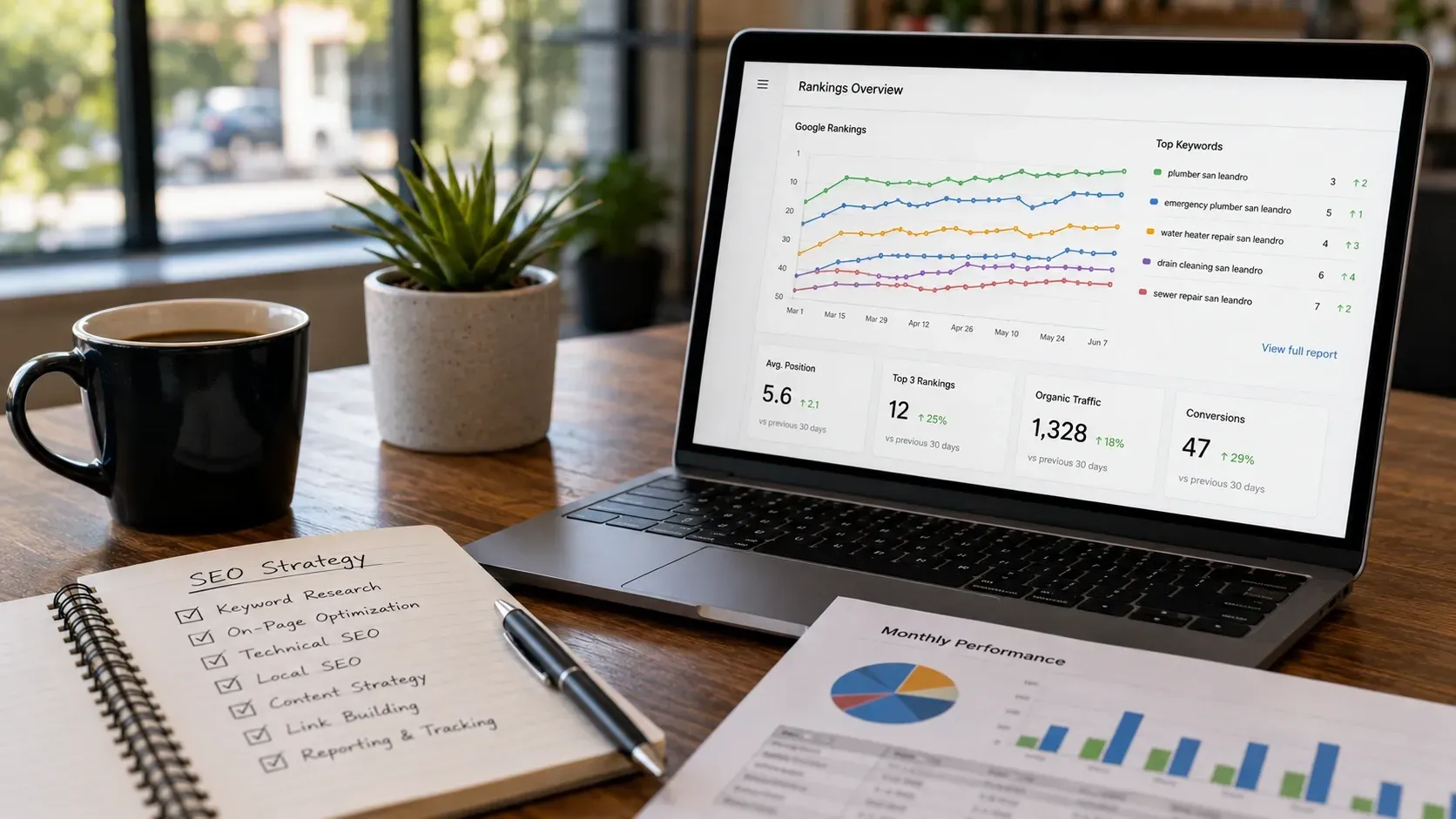
By months six through twelve, businesses with consistent effort typically see meaningful improvement in their primary service area rankings, meaning placement in the local three-pack for core search terms, not just long-tail variations.
UPM Digital Media's pay-per-result SEO model is built around exactly this reality. You pay $650 to $950 per month when ranked. You don't pay if you're not. That structure removes the financial exposure of the foundational period and aligns the agency's incentive directly with your ranking outcome. If you don't reach the first page of Google for your chosen search terms, you don't pay.
How Does Local SEO Timing Compare to Other Approaches?
| Approach |
When Results Start |
Builds Over Time |
What Happens When You Stop |
| Local SEO with UPM Digital Media |
90 to 180 days |
Yes, compounds consistently |
Rankings erode gradually without ongoing signals |
| Waiting or doing nothing |
Never |
Competitors widen the gap every month |
You fall further behind the longer you wait |
| Paid ads without any SEO |
Immediate but funded-only |
No compounding effect |
Visibility stops the moment the budget does |
| Inconsistent or unqualified SEO |
Unpredictable |
Can create conflicting signals that work against you |
May leave your listing in worse shape than before |
This table shows why timing decisions in local SEO are fundamentally different from timing decisions in paid advertising. Google Ads and local service ads produce results the moment you fund them and stop the moment you don't. Local SEO compounds. That compounding is the entire reason to start early, and the entire reason delay carries a real cost.
Paid channels and local SEO aren't competing priorities. They're sequenced tools. Paid fills the visibility gap while SEO builds the foundation. But if you never start building, you're renting that visibility indefinitely.
Who Gets the Most From Acting Now?
The businesses that get the strongest return from local SEO investment share a few characteristics. They have an established physical presence or a defined service area. They're operating in a competitive local market. And they have a business model where a single new customer carries meaningful lifetime value.
A San Jose law firm, a Walnut Creek medical practice, a San Francisco Bay Area restaurant group, a Fremont home services company: these are the businesses where local search visibility translates directly and measurably into revenue. If conversion rate optimization is already on your radar, local SEO is the upstream investment that makes it worthwhile.
The one situation where local SEO isn't your primary starting channel is when you need leads within the next 30 days and have no other channel currently running. In that case, Google Ads fills the immediate gap while SEO builds in parallel. That's not a reason to skip SEO. It's a reason to run both.
The One Insight Worth Keeping
Waiting to start local SEO doesn't protect your options. It spends them.
Ready to Stop Watching Competitors Take Your Searches?
UPM Digital Media has been helping local businesses across the United States build search presence that compounds for over 25 years. With dedicated account managers located in nearly every state, a pay-per-result model that removes your financial risk, and a free 30-minute consultation to get started, there's a clear path forward.
See what a results-driven local SEO strategy looks like for your business , or contact the team directly to schedule your free consultation. You can reach them at 415-731-9764 or toll-free at 888-449-3239, Monday through Friday, 9:00 AM to 5:00 PM.
About the Author
Les Ong is a marketing consultant and entrepreneur with deep roots in the digital media space. He specializes in helping small and medium-sized businesses compete with larger organizations through local marketing technology, with a focus on search visibility, reputation management, and pay-per-result SEO. He's the founder of UPM Digital Media and leads a team of growth-driven local marketing experts operating across the United States.
FAQ
How long does local SEO actually take to produce results?
Most local businesses start seeing measurable movement in local pack rankings between 90 and 180 days after consistent optimization begins. The first 60 to 90 days cover foundational work: profile cleanup, citation consistency, and on-page signals. Results aren't linear, and competitive markets take longer, but the timeline is predictable when the work is done consistently and maintained.
Is there a wrong time of year to start local SEO?
There's no wrong time to start, but there are smarter entry points. Starting three to four months before your peak season gives foundational work time to settle before your highest-demand period. Starting during peak season means you're building while you're already stretched, which isn't ideal for execution but is still better than continuing to wait.
What's the difference between local SEO and general SEO?
Local SEO focuses specifically on ranking your business for searches with geographic intent, such as "plumber in Fremont" or "dentist near me." It prioritizes your Google Business Profile, local citations, review signals, and proximity-based relevance. General organic SEO targets broader keyword rankings without a geographic component. For businesses with a physical location or a defined service area, local SEO is typically the higher-priority investment.
Can I handle local SEO myself, or do I need professional help?
Some foundational tasks, like claiming your Google Business Profile or correcting your listed address, are things you can do on your own. But the work that actually moves rankings, including citation building, review velocity strategy, competitive gap analysis, and on-page local signals, requires consistent execution and real technical knowledge. Doing it inconsistently often produces worse outcomes than not doing it at all, because conflicting signals reduce Google's confidence in your listing. Partial optimization isn't a safe middle ground.
What happens to my rankings if I stop doing SEO?
Rankings built through local SEO don't disappear instantly when you stop, but they do erode. Competitors who keep building signals will gradually displace you. Review recency drops. Citation freshness matters. The compounding effect works in reverse when you stop feeding it. This is structurally different from paid advertising, where results stop the moment your budget does, but the end result is the same: you lose visibility to competitors who kept going.
How do online reviews actually affect my local search ranking?
Google's local algorithm treats reviews as a prominence signal. Review quantity, recency, and how consistently you respond are all factors into how Google evaluates your business relative to competitors. A business with older reviews and no recent activity is at a structural disadvantage against a competitor with a steady stream of current reviews and active responses. Google reads recent review activity as evidence that a business is still operating and still serving customers, which directly connects to how prominently it appears in local results.
How do I know if my current local SEO is working?
The clearest indicators are your business appearing in the local three-pack for your primary service keywords, an increase in direction requests and phone calls coming through your Google Business Profile, and growth in organic traffic from local search terms in your analytics. If you can't track any of these right now, that's the first problem to solve. Visibility without measurement means you're flying blind on what's already coming in.